Home / Articles
Droopy Nose Surgery: How to Fix Sagging Tips Permanently
Home / Articles
Droopy Nose Surgery: How to Fix Sagging Tips Permanently
To understand why the nose tip sags, think of the nose as an architectural structure. Its tip is held up by cartilage, ligaments, and skin tension. Over time, or due to certain anatomical features, these supports weaken.
Common causes include:
To be honest, many patients don’t realize that the nose ages just as noticeably as the skin or jawline. That’s why tip refinement surgery is sometimes performed alongside facelift or eyelid surgery—to restore balance across the entire face rather than correcting one feature in isolation.
A droopy tip doesn’t just change the profile—it affects how others perceive your expression. A downward-pointing nose often casts shadows that make the mid-face look longer, heavier, or even tired.
In Korean aesthetics, where balance and harmony are highly valued, a sagging tip can disrupt proportions and create a less refined impression. For international patients, particularly from the West, the droopy nose is often associated with aging, as the nasal tip lengthens over time.
Patients frequently tell us:
“I look sad in photos even when I’m happy.”
“My nose looks longer every year.”
“I feel like my smile pulls my whole face downward.”
The truth is, even a millimeter of tip droop can influence how youthful, fresh, or confident you appear.
A common question patients ask is whether fillers or Botox can “lift” the nose tip. While these methods can provide a temporary illusion of support, they do not fix the underlying problem.
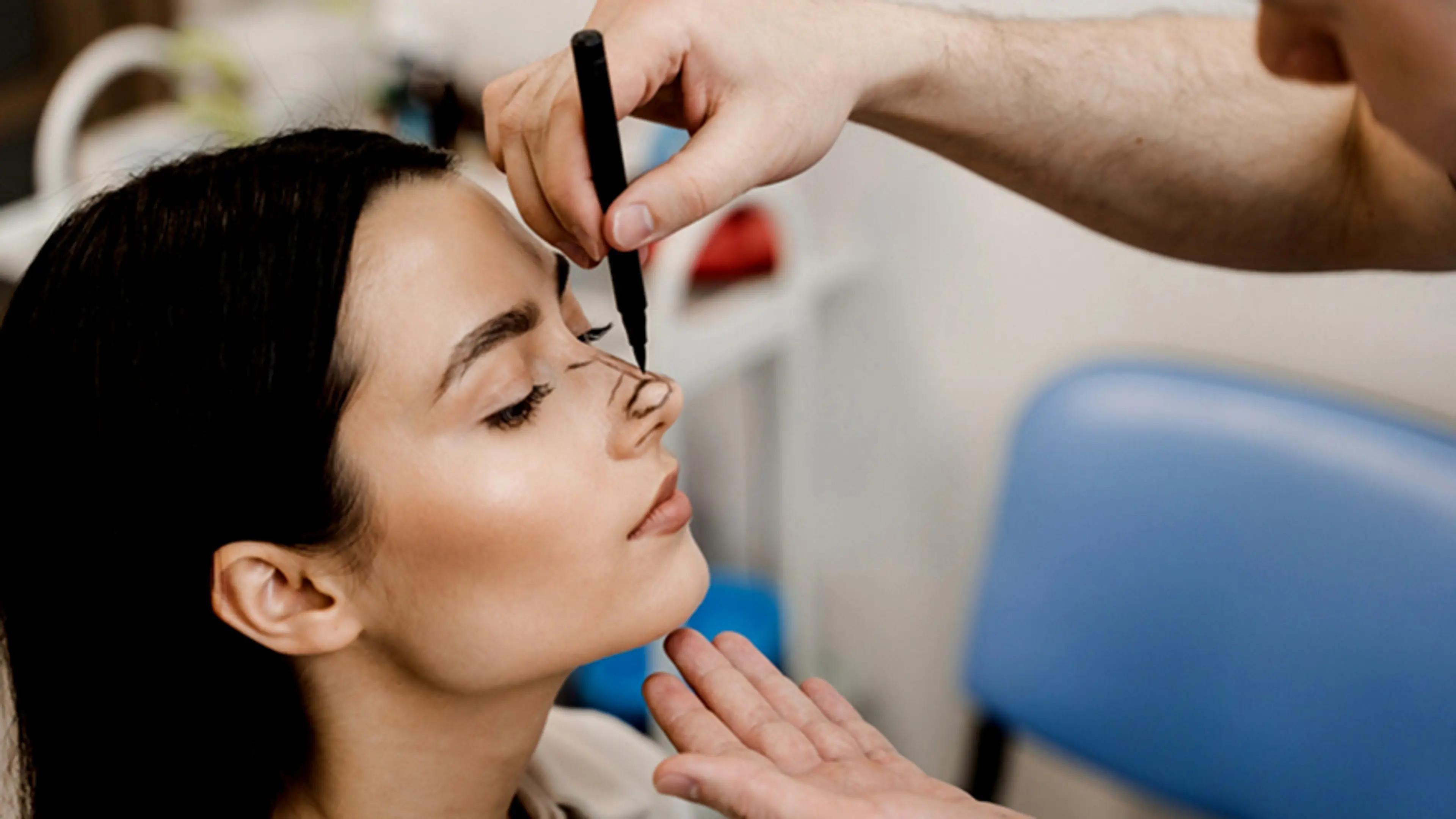
At Arke Clinic, we approach droopy nose surgery with precision and personalization. The goal isn’t to make every nose look the same—it’s to restore balance and support while keeping the result natural.
A small piece of cartilage—usually harvested from the nasal septum—is placed between the tip cartilages like a central pillar. This strengthens the foundation and prevents the tip from falling over time.
This method is ideal for patients with mild drooping caused by weak natural cartilage. It is one of the most common and reliable techniques used in droopy nose correction.
For patients with significant droop or weak nasal structures, a septal extension graft is often necessary. By extending the central cartilage forward, we can lift the nasal tip, adjust its projection, and control its rotation with great precision.
This technique provides excellent long-term stability, making it especially useful for patients seeking a permanent correction or those with revision cases.
When the depressor septi nasi muscle is the main culprit, a surgical release can be performed. By carefully weakening or detaching this muscle, the tip no longer pulls downward when the patient smiles.
This is a subtle but important step in ensuring the results look natural in dynamic expressions—not just when the face is at rest.
In reality, most droopy nose surgeries use a combination of the above methods. For example, a patient may receive a septal extension graft for structural support and a muscle release to prevent downward pull when smiling. Each plan is tailored to the patient’s anatomy and desired outcome.
Droopy nose surgery is performed under local anesthesia with sedation or general anesthesia depending on complexity. The recovery is very similar to standard rhinoplasty:
Most patients describe the recovery as manageable. The biggest adjustment is not the pain but simply waiting for the swelling to fade so they can fully enjoy their results.
The transformation after droopy nose surgery is often subtle yet powerful. Patients notice that:
Their nose no longer appears to lengthen when they smile.
Their overall expression feels more open and youthful.
The face looks more proportional, especially in profile.
That’s the philosophy at Arke Clinic—results that enhance confidence without shouting “plastic surgery.”
Seoul, and Gangnam in particular, has become a hub for advanced rhinoplasty because of the demand for both natural aesthetics and precise surgical technique. International patients travel here because Korean surgeons are known for their ability to achieve subtle refinements that look harmonious, not artificial.
If you notice your tip drooping when you smile, or you feel your nose has grown longer with age, you may be a candidate for droopy nose surgery. A personalized consultation is essential to determine whether cartilage support, grafting, or muscle release—or a combination—will give you the best result.
What many patients overlook is that droopy tip correction is not only cosmetic. By stabilizing the nasal structure, it can also improve breathing in cases where collapse or obstruction is present. This is why it’s important to see a clinic that approaches rhinoplasty not just as an aesthetic change, but as a structural reconstruction.
A droopy nose may seem like a small detail, but it can change the way your entire face is read by others. Correcting it is less about “cosmetic perfection” and more about restoring natural balance and expression.
If you’ve been considering this procedure, consult with a trusted clinic in Gangnam like Arke, where the approach is tailored to your unique anatomy and long-term wellbeing. With the right surgical planning, a sagging nasal tip can be lifted permanently—giving you results that age gracefully along with you.